The Prayer to Saint Michael and Its Origins with Pope Leo XIII
Few prayers have been prayed as widely, or as hard, as the Prayer to Saint Michael the Archangel. Its words are short and martial. It asks for a defender in battle and a protector against the devil.
The prayer
Saint Michael the Archangel, defend us in battle. Be our protection against the wickedness and snares of the devil. May God rebuke him, we humbly pray; and do thou, O Prince of the heavenly host, by the power of God, thrust into hell Satan and all the evil spirits who prowl about the world seeking the ruin of souls. Amen.
Sancte Michael Archangele, defende nos in proelio; contra nequitiam et insidias diaboli esto praesidium. Imperet illi Deus, supplices deprecamur: tuque, Princeps militiae caelestis, Satanam aliosque spiritus malignos, qui ad perditionem animarum pervagantur in mundo, divina virtute in infernum detrude. Amen.
Who is Michael?
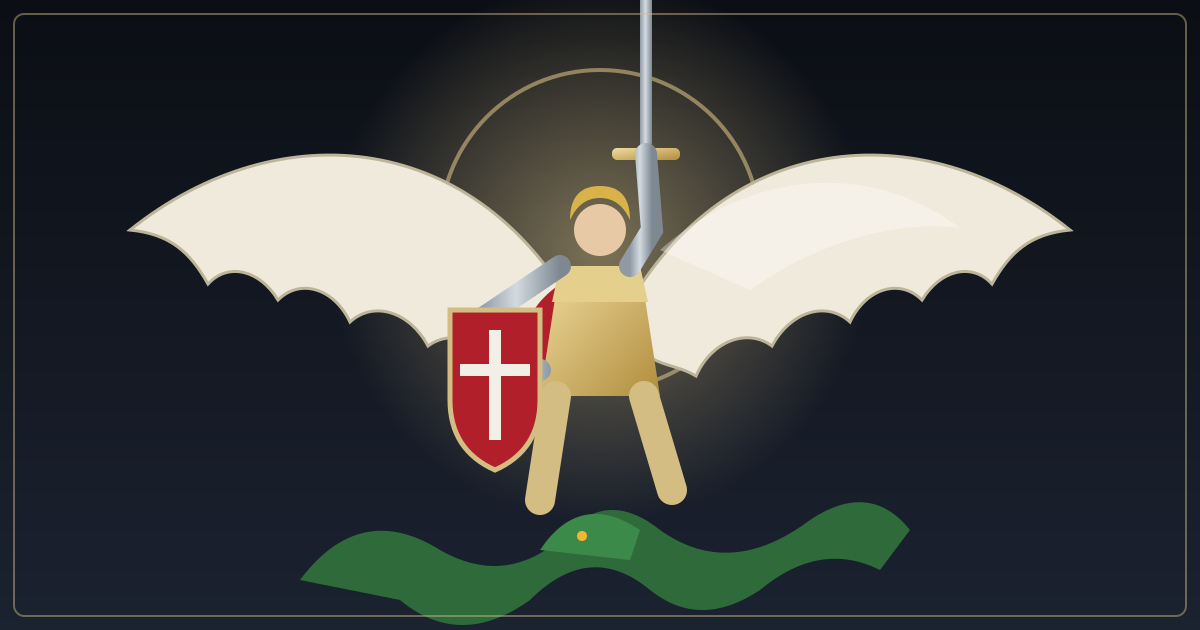
His Hebrew name asks a question: "Who is like God?" Scripture shows him as a warrior. In the Book of Daniel he is the great prince who stands guard over God's people (Daniel 12:1). In the Epistle of Jude he contends with the devil over the body of Moses (Jude 9). And in Revelation: "And there was a great battle in heaven, Michael and his angels fought with the dragon" (Revelation 12:7). The Church has long honored him as her protector and as patron of soldiers and police.
Origins under Leo XIII
In 1884 Pope Leo XIII ordered a set of prayers to be said after every Low Mass, now called the Leonine Prayers. They sought God's help for the Church after the Pope had lost his temporal domain, the Papal States, in 1870, when the Kingdom of Italy seized Rome. Leo and his successors considered themselves prisoners in the Vatican, a standoff known as the Roman Question, and his concern for the Church's independence was real. In 1886 the Prayer to Saint Michael was added. For nearly eighty years Catholics around the world said it at the end of Mass, until the Leonine Prayers were suppressed by the instruction Inter Oecumenici of 1964, effective in 1965.
The vision story
A tradition says that after Mass one morning Leo XIII stood as if transfixed, then hurried to his office and wrote the prayer. A fuller version says he had seen a vision of demons gathering over Rome, or overheard Satan boasting that, given time and power, he could destroy the Church.
Here the historical record is thinner than the legend. Father Domenico Pechenino, who worked in the Vatican, wrote in 1947 that the Pope seemed to be staring at something and about half an hour later had composed the prayer. He did not mention a vision or give a date. The detailed accounts of a dialogue with Satan appear in print only decades later, and they disagree about when it happened. So treat the vision as a pious tradition, not established history. The prayer does not depend on it.
The exorcism, and today
In 1890 Leo XIII also issued a much longer exorcism prayer for bishops and authorized exorcists, which opens with a prayer to Saint Michael. That formula is not for private use. The short prayer, however, is for everyone. In October 2018 Pope Francis asked Catholics around the world to pray the Rosary each day of that month and to close it with the Prayer to Saint Michael, asking the Archangel to defend the Church from the devil.
For men who count themselves soldiers of Christ, there is no better daily prayer. Pray it morning and night.